

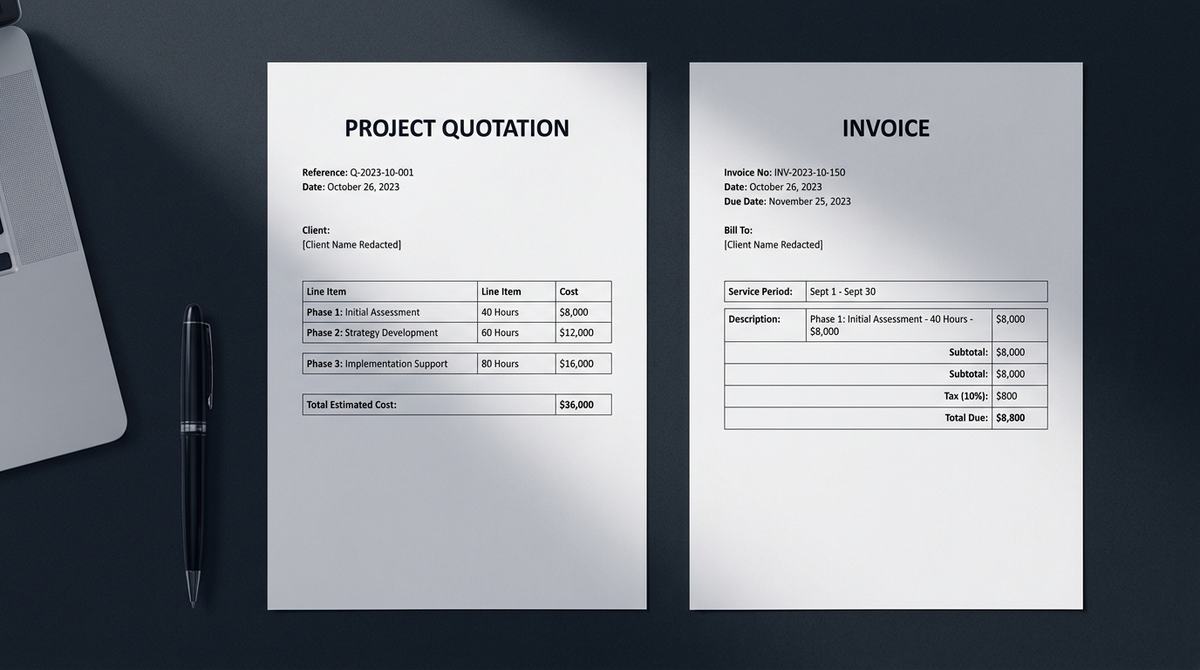
Freelancers mix these two documents up all the time, and clients do too. They look alike, they carry the same line items, and both end in a total. But they do completely different jobs at completely different moments, and using the wrong one at the wrong time can cost you money or the whole project.
The short version
- A quotation (also called a quote or an estimate) says: "Here is what I would charge for this work."
- An invoice says: "I did the work, and here is what you owe me."
One is an offer. The other is a request for payment. Everything else follows from that difference.
What a quotation is for
A quotation comes before the work. It helps the client decide whether to hire you, and it protects you by putting the scope and the price in writing before either of you has spent any time or money.
A good quotation lists what is included, what each part costs, how long the price is valid for, and any terms such as a deposit or the number of revisions. It is a sales document as much as an administrative one: a clear, well-organised quote makes you look like someone who will run the project the same way.
Because it is an offer, the client can accept it, negotiate it, or walk away. Until they accept, no money is owed and you have no obligation to start.
What an invoice is for
An invoice comes after the work, or at an agreed milestone. It is a formal request for payment. It carries an invoice number, an issue date, a due date and your payment details, and it becomes the record both of you keep for accounts and, usually, for tax.
An invoice is not an offer. By the time you send it, the price has already been agreed. Its job is to make payment easy and to leave a clean paper trail.
Side by side
| Quotation | Invoice | |
|---|---|---|
| When | Before the work | After the work or at a milestone |
| Purpose | Win the job, agree the scope | Get paid, keep records |
| Key date | Valid until | Due date |
| Number | Quote number (QUO-001) | Invoice number (INV-001) |
| Money owed? | No, not until accepted and done | Yes, by the due date |
| Can the client say no? | Yes, it is an offer | Only if the work was not as agreed |
How one leads to the other
- The client asks about a job.
- You send a quotation with the scope, the price and a valid-until date.
- The client says yes, ideally in writing.
- You do the work, or the first milestone.
- You send an invoice using the same line items and prices from the accepted quote.
Reusing the quote's figures matters more than it sounds. If the invoice total suddenly differs from the quote, you will spend a day explaining why. If the scope genuinely changed, say so on the invoice and point to exactly what changed and who asked for it.
An example
Quotation QUO-007. Brand identity for Northwind Co. Logo (3 concepts, 2 revisions) $900, colour palette and type guide $300, social media kit $250. Total $1,450. Valid until 30 November. 40% deposit to start.
Invoice INV-012 (sent after the logo is approved). Deposit already paid $580. Balance for logo, palette and guide $620. Due in 14 days.
Notice how the invoice refers back to the quote. The client never has to wonder where the numbers came from.
Is a quotation legally binding?
It depends on where you live and how the quote is worded. In many places, a quote that the client accepts can become part of a contract, which is a good reason to be precise and to include a valid-until date. If you need a firm answer for a large job, ask a local professional. This is general guidance, not legal advice.
When you can skip the quote
For a small, repeat job where the client already knows your price, a quote is an extra step nobody needs. For anything new, large or vague, send one. It takes ten minutes and prevents arguments that take ten days.
Common mistakes
- Sending an invoice when you meant to send a quote. The client thinks they already owe you money and may push back.
- No valid-until date on a quote. A client can come back a year later expecting last year's price.
- Different numbers on the invoice. Always carry the quoted figures through, and flag any change in writing.
- Mixing the numbering. Keep quote numbers and invoice numbers in separate sequences so your records stay clean.
Both documents are quick to make with the free tools on this site, and the FreelanceDesk app can turn an accepted quotation into an invoice in a single tap.
Make your next one in minutes.
Create a free invoice or quotation in your browser, or get the FreelanceDesk app to handle clients, payments and income.